
Mobile App Testing Services in 2026: Devices, Store Rules and Cost
This guide explains what mobile app testing services cover, how to size a device matrix from United States traffic data, and what Apple and Google check before a rel…
Vervali delivers vulnerability assessment and penetration testing across web applications, APIs, mobile apps, source code and infrastructure, black-box and grey-box, with threat modelling, attack-path analysis, controlled exploitation and revalidation after fixes. Reports are risk-ranked and audit-ready, and every engagement ends with a retest of the agreed in-scope assets.

ISO/IEC 17025:2017Accredited testing laboratory

CMMI Maturity Level 3The process is written down and repeats

ISO 9001:2015Quality management

ISO/IEC 27001Information security
This is the method page: web, API, mobile, network and infrastructure, and cloud configuration. 100% coverage of agreed in-scope. US product and security teams get this work in US hours, 9am to 1pm Eastern, with delivery from India, under ISO/IEC 27001. We do not claim certified security staff. The overview that routes the rest of the set is security testing. A free external attack-surface check of one domain is the first look from the outside.
Authenticated and unauthenticated. Business logic as well as the standard classes a scanner lists. In scope by default: the URLs and roles you named. Out of scope until agreed: a neighbour tenant, a third-party widget you do not own, and production data we have not been given.
Authorisation between accounts is the finding that matters most, and the one automated tools miss. In scope by default: the endpoints and roles you named. Object-level access, token handling and rate limits sit in the work. A dedicated layer page is API security testing.
The app, its storage, and what it sends. In scope by default: the builds and OS versions you named. Certificate pinning, local storage and the traffic to your API sit here. The dedicated layer page is mobile security testing.
Exposed services, segmentation, and the host nobody patched. In scope by default: the agreed in-scope hosts and segments. A full infrastructure-only pass sits on infrastructure security testing. Network and wireless slices sit next door when that is the only problem.
Identity, permissions and public storage. In scope by default: the accounts and subscriptions you named. Hardening evidence for an auditor sits on cloud security and compliance. A test of the account without the application pentest sits on cloud security testing.
Every engagement ends with a retest of the agreed in-scope assets. Findings are revalidated after your team fixes them. That retest is part of the original work, not a second sale. 100% coverage of agreed in-scope.
Need an authorised attacker and a retest, not another scanner dump? Book a scoping call, or start with a free external attack-surface check of one domain.
Book a CallBuyers get quoted for both and do not know the difference. Black box is closest to a real attacker. Grey box covers more per day when the application has roles. White box is a code review rather than a penetration test. We recommend grey box by default when there are roles to test. Book a scoping call if you have been quoted both and need one decision.
No credentials, no source. Closest to a real attacker. Slower. It will miss anything sitting behind a login you did not give us. Buy this when the question is what an outsider can reach from the internet, and you can live with the gaps behind authentication.
Credentials and some documentation. More coverage per tester-day. This is the one to buy if the application has roles, because authorisation between accounts is the finding that matters. Vervali recommends grey box by default for a product with logins. A one-application grey-box test with a retest is the usual shape.
Source and design notes in the tester's hands. That is a code review, not a penetration test. We will say so in the quote if that is what you asked for. Do not buy a white-box day-rate and call it a pentest. The overview for SAST and DAST coordination sits on security testing.
The method, with the tools named because a technical buyer scans for them. Written authorisation first. We do not start without it. 100% coverage of agreed in-scope. Retest of every finding after remediation is included, not sold again.
Named assets, named roles, named windows, and what we will not touch. Third-party hosts and cloud accounts need that owner's written go-ahead as well. Scope is where these engagements go wrong. We write it down first.
What an attacker would actually try against the agreed in-scope set, before a tool is pointed at it. Attack-path analysis sits in this step, not in a PDF appendix after the scan.
OWASP Top 10 and ASVS levels against the surface you named. Controlled exploitation inside the limits agreed in writing. Tools used on the work: Burp Suite, OWASP ZAP, Metasploit, Tenable, OpenVAS, MobSF, Frida, Wireshark. A scanner dump with no owner is not the engagement.
Risk-ranked findings with a path to harm, written for engineering and for an auditor. Then a retest of the agreed in-scope assets after your team fixes them. If a new release changes the surface, that is a new scope, not a free extension of the last one.
There is no single number that fits every engagement. We quote in tester-days after the agreed in-scope list is written down. We do not publish a day-rate on this page. A one-application grey-box test with a retest is the usual shape. The drivers are set out in our pentest cost guide.
How many applications and how many roles. Whether APIs and mobile are in scope. Black box against grey box. Whether a retest is included. Whether a formal report for an auditor is required. Add a host set or a cloud account and the tester-days move. We write that list before anyone points a tool.
A vulnerability assessment is usually shorter because it finds and ranks issues without proving an attack path. A pentest goes further. If you need exploitation and an audit-ready report, you want a pentest, not a scan. See the vulnerability assessment guide. Book a scoping call for a number against your assets.
Country and sector only, except where a name is permitted. Tools are the ones used on the work. 100% coverage of agreed in-scope.
Anonymous bank · VAPT and audit evidence
Before: vulnerability noise was burying the work that mattered, fixes took over 40 days, and audit preparation took five days. After: 68% less vulnerability noise, time to fix under 16 days, audit preparation from 5 days to 5 hours, and a 3.5 times high-risk closure rate.
68% less vulnerability noise TTF from 40+ days to under 16 Audit prep 5 days to 5 hours 3.5x high-risk closureDigital recharge and payments platform · infrastructure VAPT
Infrastructure VAPT across the exposed surface. Tools used on the engagement: Burp Suite, Metasploit, Tenable, OpenVAS and Wireshark. The report was risk-ranked. Findings were retested after remediation.
Infrastructure VAPT Burp Suite · Metasploit · Tenable OpenVAS · WiresharkGlobal marine technology organisation · web and infrastructure
Web and infrastructure VAPT against the OWASP Top 10. Sector and work type only.
Web and infrastructure OWASP Top 10UAE · fintech platform · API VAPT
API VAPT on a fintech platform. Authorisation between accounts is the class of finding this work is for. The client stays unnamed.
API VAPT UAE fintechSaaS gaming platform · end-to-end VAPT
End-to-end VAPT across web, mobile, API, source code and infrastructure. Mobile work used MobSF and Frida. One engagement, one report, a retest of the agreed in-scope assets.
Web · mobile · API · source · infra MobSF · FridaThe requirement, what it asks for, and what Vervali does about it. We test your controls and produce evidence. An auditor or a QSA signs. Vervali tests a client system for SOC 2 readiness and is not itself SOC 2 certified. Control-by-control work sits on compliance testing.
Penetration testing of the cardholder environment and the segmentation that is supposed to hold. We test whether those controls would stand up to a PCI conversation. That is not a certificate. A QSA is a different vendor.
Access control, audit trails and transmission security on the agreed in-scope systems. We test the controls and the evidence. We do not certify a covered entity.
Controls we test and evidence we produce, never a Vervali credential. An auditor issues the report. We will not write SOC 2 as something Vervali holds.
Findings and retest records a buyer can put in a file. Vervali holds ISO/IEC 27001 for its own information security. That is not a substitute for testing your estate.

OUR BLOGS
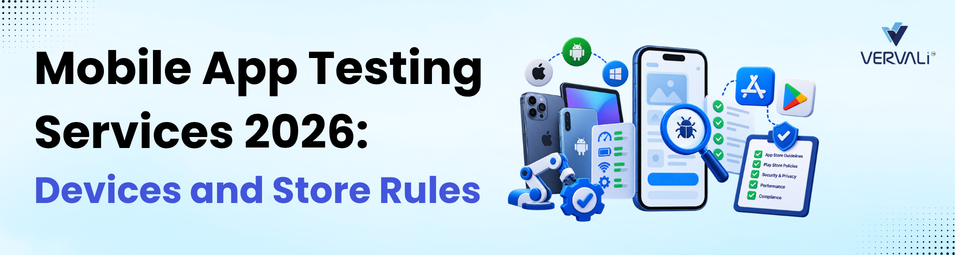
This guide explains what mobile app testing services cover, how to size a device matrix from United States traffic data, and what Apple and Google check before a rel…

This guide prices the five QA outsourcing engagement models against the cost of an in-house hire, and names the situations where outsourcing is the wrong call.
This article ranks nine software testing companies on their verified review evidence and engagement floors, and sets out the criteria before the ranking.
A ranked comparison of ten IT staff augmentation vendors on verified Clutch data, with the ranking criteria stated before the list. Covers why the highest-rated firm…
Penetration testing is priced by tester-days multiplied by a day rate, plus reporting and retest. This guide sets out the seven variables that move a quote, how to e…
A dedicated development team is a contract for a named group of engineers who work only on your product, with the vendor carrying employment, replacement and infrast…
Two vendor proposals can both say VAPT, land at the same price, and cover completely different work. This buyer's guide fixes the four scope dimensions that decide w…
ADA compliance has no single yes or no answer, because three different US regimes name three different WCAG versions. This guide shows which one applies to you, give…

Our Expertise


Trusted by 150+ Leading Brands

A Strong Team of 275+ QA and Dev Professionals

Worked across 450+ Successful Projects
 Email Us
 Call Us
From flawless code to flawless quality - we design, develop, and test digital solutions that deliver real results.