QA Testing Services for SaaS Startups: How Vervali Works
How Vervali tests a SaaS startup's product: what to test first, when to outsource, manual or automation, the monthly cost at published rates, and how the free pilot…
Vervali runs test automation as a service for US software teams: it designs the framework, builds the suite for web, mobile or API products, runs it in GitHub Actions, Jenkins or Azure DevOps on every build, and keeps it passing on a monthly allocation named in the quote. Each failure comes back sorted as a product defect, a test defect or an environment issue, with an owner and evidence. Suites are written in Selenium, Playwright, Cypress, Appium, REST Assured or k6. Engineers work from India with a 9am to 1pm Eastern overlap, typical work is $25 to $49 an hour, and a free readiness review of one suite comes first.


ISO/IEC 17025:2017Accredited testing laboratory

CMMI Maturity Level 3The process is written down and repeats

ISO 9001:2015Quality management

ISO/IEC 27001Information security
Vervali's test automation as a service gives a US software team a framework, a suite and the monthly upkeep to keep it passing, without hiring an automation team.
A framework that fits the product stack, team language and browser or device matrix. Playwright work has its own page, Playwright testing services.
The suite is built for web, mobile or API products. Smoke tests on every build come first, then the path that takes money.
The suite runs in GitHub Actions, Jenkins or Azure DevOps on every build, with results triaged and not left as a red build.
Each failure is a product defect, a test defect or an environment issue, with an owner and evidence attached.
Intermittent failures are measured, assigned and removed, so the team keeps trusting the result.
Maintenance capacity for product, browser, device and pipeline changes is named in the quote, so nothing is left as a surprise.
Every run ends with a report of what changed since the previous run, so you always know what moved, what broke and who is fixing it.
Find out whether your suite is ready to be managed, and what a month will cost.
Get My Free Suite ReviewTest automation as a service is Vervali's Build and Maintain shape: the monthly allocation is in the quote and Vervali keeps the suite green, and year two continues the same operating model.
| Shape | What you get | It fits when |
|---|---|---|
Build and Hand Over |
Quoted to a working suite in your pipeline. You own it and run it. | Your QA team can keep locators alive. |
Build and MaintainTest automation as a service |
The monthly allocation is in the quote and Vervali keeps the suite green. Year two continues the same operating model. | You want a passing suite without hiring an automation team. |
Dedicated Automation Engineer |
A named person inside your team, billed monthly. | Your backlog will still be there after the first suite. |
Run cost under Build and Hand Over is your CI and your people. Under Build and Maintain it is the monthly allocation plus CI. Who owns the test code is stated in the quote before work starts. The full range of tools and shapes is on test automation services.
Vervali prices test automation as a service as a monthly allocation named in the quote, at a typical $25 to $49 an hour, so the monthly cost is that allocation plus your CI.
Every quote names environment, data and tool costs upfront. More on rates and engagement models.
This is arithmetic, not a quote: 40 hours a month at $25 to $49 an hour is $1,000 to $1,960, plus your CI.
CI minutes and any hosted browser grid run on your accounts, so you see that cost directly.
The monthly figure moves with the hours in the allocation, the products covered and the browsers or devices in scope, and the quote shows each one.
If the UI still changes every week, automation will not pay back, and Vervali says so in the readiness review rather than sell the suite, before any build starts. Vervali also names the tests that are not worth automating.
The service pays back when the suite runs on every build, locators are stable enough to keep a flakiness budget, and maintenance is allocated monthly. Until then, the money is better spent elsewhere.
Vervali answers these six questions in one line each, and you can hold any other vendor to them.
Ownership is stated in the quote before work starts.
As a product defect, a test defect or an environment issue, each with an owner and evidence.
Intermittent failures are measured, assigned and removed under a flakiness budget.
Yes, named for product, browser, device and pipeline changes.
The same operating model continues instead of repeating the build.
What changed since the previous run.
In an ordinary month, Vervali runs your suite on every build and returns every failure classified, so your team sees what to fix and who owns it.
Nothing here needs a new hire on your side: your team reads the report and fixes the product defects, and Vervali handles the rest. Nothing waits for the end of the month. Stand-ups and go-live calls fall in the 9am to 1pm Eastern overlap, with delivery from India.
Vervali automated the stable, high-value journeys and left changing risks to human testers.
India · major airline · booking and check-in
Coverage on booking and check-in was too thin for the release pace. Results after two release cycles:
85% test coverage70% fewer customer-reported issuesUAE · SME finance platform · web and mobile
Testing time was eating the sprint. Results after automating the repeatable journeys:
40% less testing time98% user satisfaction
OUR BLOGS

How Vervali tests a SaaS startup's product: what to test first, when to outsource, manual or automation, the monthly cost at published rates, and how the free pilot…

Vervali offers test automation as a service: framework, suite, CI integration and maintenance on a monthly allocation, from India with a 9am to 1pm Eastern overlap.

Vervali publishes what Shopify and ecommerce testing costs: hourly rates by role, monthly billing for a dedicated tester or retainer, a fixed price for a pre-peak lo…
Every path through a use case becomes at least one test case. A worked bank-transfer example shows the test table, and ISTQB's 2023 and 2025 syllabus changes explain…
What a soak test is, how it differs from load, stress and spike tests, how long to run it, the metrics that decide a pass, and how JMeter, k6 and Gatling hold a load…
This software testing checklist groups every item by the phase of the test process it belongs to, marks the items teams routinely skip, and shows how to wire the lis…
This guide explains what a QA maturity assessment scores you against, what the deliverable looks like on the last day, and when advisory work is the wrong purchase.
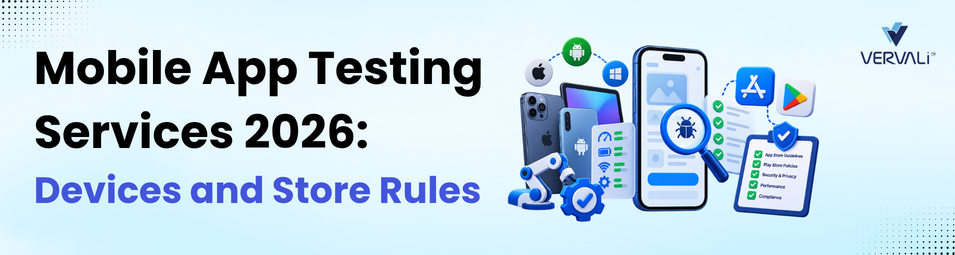
This guide explains what mobile app testing services cover, how to size a device matrix from United States traffic data, and what Apple and Google check before a rel…

Our Expertise


Trusted by 150+ Leading Brands

A Strong Team of 275+ QA and Dev Professionals

Worked across 450+ Successful Projects
 Email Us
 Call Us
From flawless code to flawless quality - we design, develop, and test digital solutions that deliver real results.